Pribram.eu O městě Mezinárodní vztahy Partnerská města Valle di Ledro
Mezinárod. vz. Partnerská mě. Valle di Ledro
Valle di Ledro
Partnership Agreement
On 28 June 2008, a Partnership Agreement was signed between the Association of Municipalities of Valle di Ledro, on the one hand, and eight Czech towns and municipalities (Příbram, Všeň, Milín, Buštěhrad, Nový Knín, Ptice, Chyňava, Doksy) on the other.
Valle di Ledro
The municipality of Ledro was formed by the amalgamation of the former municipalities of Tiarno di Sopra, Tiarno di Sotto, Bezzecca, Concei, Pieve di Ledro and Molina di Ledro, which together constituted the Association of Municipalities of Valle di Ledro. The municipality is situated in the province of Trentino, 40 km south-west of Trento. It has a population of over 5,000.
History, tourism, sport and a Czech connection
The Valle di Ledro valley is situated in northern Italy, in the south-western part of the province of Trentino, on the border with Lombardy. It is just under 60 kilometres from Trento, the capital of the province of Trentino, which is famous for having hosted the Council of Trent in the 16th century. Valle di Ledro is easily accessible by car, train (Trento and Rovereto railway stations) and bus.
Valle di Ledro lies in a valley between Lake Garda (Italy’s largest lake) and Lake Idro. It has a rich history. In 1927, the remains of houses built on stilts were discovered in the eastern part of Lake Garda, providing evidence that people settled in this area more than 5,000 years ago. The remains of these dwellings concealed many treasures – jewellery (some made from Baltic amber) and everyday objects, which are now housed in the local museum and are listed as a UNESCO World Heritage Site.
The Valle di Ledro is characterised by a distinctive climate, ranging from alpine to Mediterranean, thanks to its location, which spans altitudes from 60 metres to over 2,000 metres above sea level. The local flora and fauna are also highly distinctive. The Tremalzo Pass, for example, is renowned for the migration of birds from Central Europe. There is a bird-ringing centre here, organised by the local museum, which specialises in the study of bird migration. In recent years, the pass has also become one of the main tourist attractions, thanks to the magnificent views stretching from Lake Garda across the Apennines to the high Alpine peaks of western Trentino.
The Valle di Ledro is becoming a sought-after tourist destination, attracting visitors from all over Italy and Europe, who are increasingly choosing the Ledro Valley as their holiday destination. It is no coincidence that the Valle di Ledro ranks amongst the top ten most-visited holiday destinations in the Trentino region. Tourism in the Ledro Valley is ideal for active holidays, which include various outdoor activities, as well as for relaxing breaks. The lake is a major attraction, serving as the hub for many sporting activities such as swimming, sailing, canoeing and stand-up paddleboarding. Many locals and tourists enjoy running and cycling. Adrenaline-fuelled experiences such as paragliding and canyoning are also popular. The Valle di Ledro frequently hosts major sporting events, such as the Italian Canoeing Championships, the Ledro Skyrace, Ledro Running and the Ledro Trentino Trail. One of the leading figures on the local sporting scene is cross-country skier Federico Pellegrino (world champion and silver medallist at the 2018 Winter Olympics in cross-country skiing) and middle-distance runner Yeman Crippa.
The Valle di Concei is also well worth a visit; here you’ll find a small theme park particularly popular with families with children. Here you can admire dozens of wooden sculptures created by local artists from the LederLegn association, which are scattered throughout the park. All are inspired by the legend of the fairy Gavardina.
Another option for an immersive cultural experience is Ledro Land Art, an art park situated in the Pur forest area, where you can view dozens of artworks crafted from natural materials. Two or three new works are added every year. Also not to be missed are the two churches in Tiarno di Sopra and Tiarno di Sotto, which are renowned for their rare 16th-century frescoes and paintings, as well as an altarpiece by Tintoretto. The bell tower in the village of Tiarno di Sotto is one of the tallest in Italy.
The local restaurants are a major attraction for tourists, offering Italian cuisine as well as some Czech and Moravian dishes. The recipes for these dishes were brought back from Bohemia by the ancestors of the valley’s current inhabitants, who were forced to move there during the First World War to escape the approaching front line. You can try bread dumplings, potato polenta and many other dishes.
During the First World War, the Valle di Ledro valley belonged to South Tyrol, which was part of the Austro-Hungarian Empire at the time. As soon as Italy entered the war in May 1915, the Valle di Ledro became the southern Austro-Hungarian line of defence, and so the Austrian military commanders decided to evacuate the entire civilian population, who were subsequently relocated to the interior of the empire, including Bohemia and Moravia. The civilian population, consisting mainly of women, the elderly and children, was divided into groups, each of which was assigned to a specific village. A year earlier, in 1914, men aged between 16 and 50 had been conscripted, enlisted in the Austro-Hungarian Army and sent mainly to the Eastern Front in Galicia to fight against the Russian army.
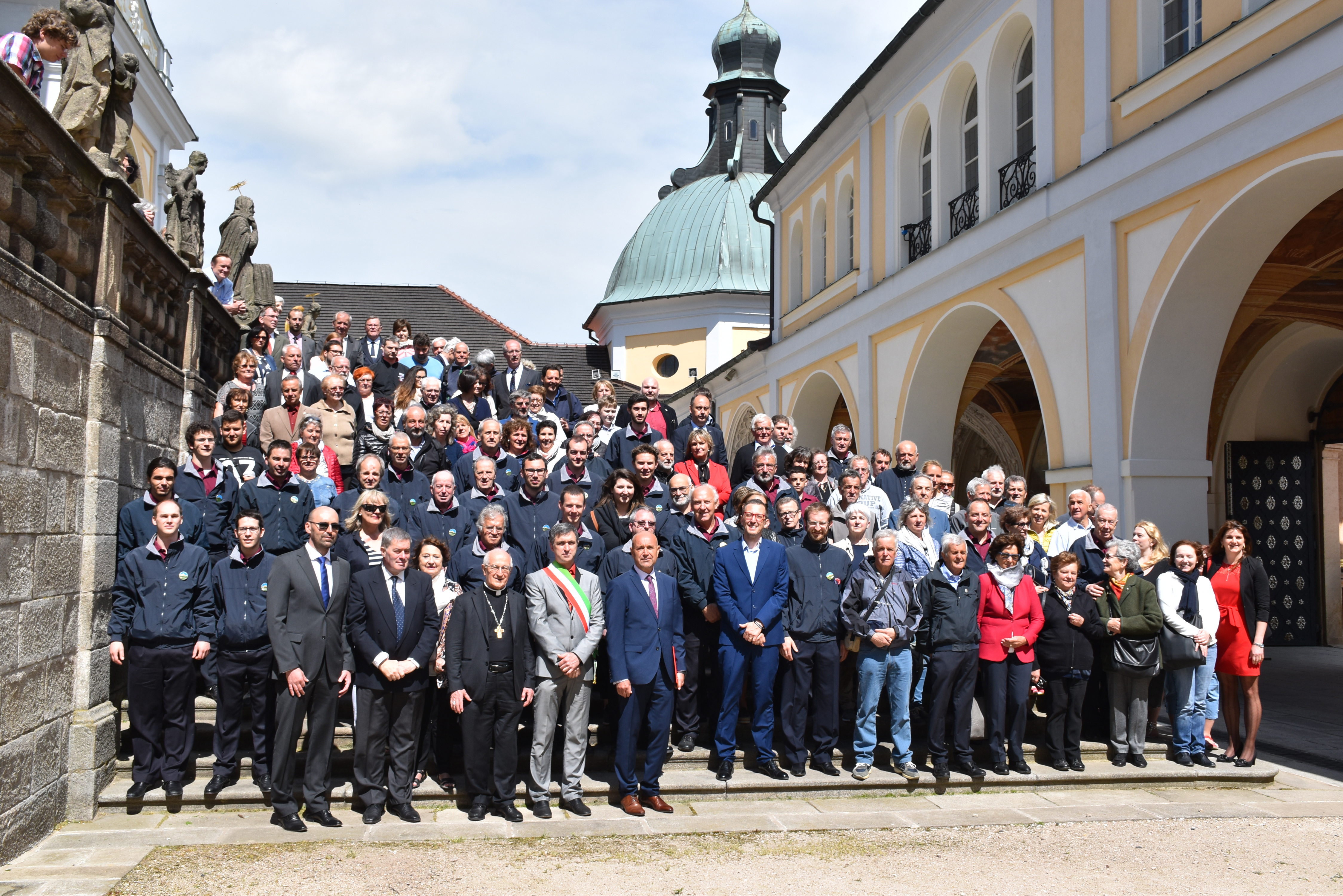
After initial difficulties caused mainly by language barriers and cultural differences, as well as the difficult circumstances in which the inhabitants of the selected Czech and Moravian towns and villages themselves were living, the families from Ledrn gradually began to integrate into the Czech communities. When, after four years of living together, the time came to say goodbye, many tears were shed. As a memento of those sad years and with the aim of re-establishing ties with Czech friends, a partnership agreement was drawn up in Valle di Ledro in 2008 between six municipalities from Valle di Ledro and eight Czech municipalities selected from among the many that had hosted Ledro refugees during the First World War I. These are the municipalities of Buštěhrad, Chyňava, Doksy, Milín, Nový Knín, Příbram, Ptice and Všeň. In the Příbram district in particular, there were many large groups of refugees from Ledro, totalling 683 people divided among families in Příbram, Březové Hory, Milín, Nový Knín and other neighbouring municipalities. In 2009, at the Basilica on Svatá Hora, in the presence of the mayors of the twin towns, some five hundred residents of Ledro and over a thousand Czech friends, a monument made of bronze and granite was unveiled in memory of more than four hundred residents of Ledro who are laid to rest in Czech and Moravian cemeteries. Since then, the twin towns have been showing great initiative, particularly in the fields of culture and education. In honour of the town of Příbram, one of the streets near the lake in the village of Pieve in the Valle di Ledro has been named after it.
A Shared History
In 2018, we commemorated the 100th anniversary of the return of war refugees to their homeland. The time that has elapsed since then is, after all, a long one, and our shared story could easily be forgotten. We would like it to live on. That is why, in 2018, with the help of Věra Smolová and staff at the Jan Drda Library, the town organised a literary and art competition for pupils at primary and secondary schools in Příbram. The children were able to learn about the events that shaped their town a hundred years ago and empathise with the fates of the Italian children. They expressed their impressions in short stories and drawings, which were published in the anthology *Memoria Viva – Living Memories*. The anthology was then presented to the residents of Valle di Ledro, who visited Příbram in April 2018.
The partnership between the 28 October Primary School and the school in Valle di Ledro is very active. Children from Příbram visited their Italian friends in June 2019, learnt about the local history and natural surroundings, and made new friends. There is also collaboration between nativity scene makers from both communities, and thanks to this, over the last few years you have been able to admire nativity scenes from Valle di Ledro at Svatá Hora during the Christmas holidays. Part of the new leisure park around Čekalíkovský Pond will also be dedicated to the friendship between our towns; it is hoped that it will be open to the public as early as 2021.
You can find details about Valle di Ledra on the website vallediledro.com.
Don’t miss
May: Flower Festival in Dromae
August: A Night in the Stilt House – a competition with the chance to win a night’s stay in the house as a Bronze Age person
September: St Michael’s Day with a livestock show featuring animals from across the valley
December: Christmas markets inspired by Bernard Gilli, a giant who lived in the 18th century, stood 2.6 metres tall and visited many royal courts across Europe during his lifetime.
How the people of Ledro live
The economy of the Valle di Ledro is based primarily on tourism, with significant links to agriculture, craft production, small-scale industry, trade and services. The entire area falls under a single local authority, which was formed ten years ago through the merger of six municipalities: Bezzecca, Concei, Molina di Ledro, Pieve di Ledro, Tiarno di Sopra and Tiarno di Sotto. The current mayor is Renato Girardi, who was recently re-elected to the post. Valle di Ledro has a population of approximately 5,600.
The municipality has a nursery school (for children up to 6 years old), a primary school (ages 6–11) and a lower secondary school (ages 11–14). Pupils attending secondary schools (technical colleges or grammar schools) commute to the town of Riva del Garda, which is 15 km away. Universities are located in Trento (54 km), Verona, Padua, Venice, Bologna, Parma, Brescia and Milan.
Updated: 31. 5. 2026 v 22:03:08

